
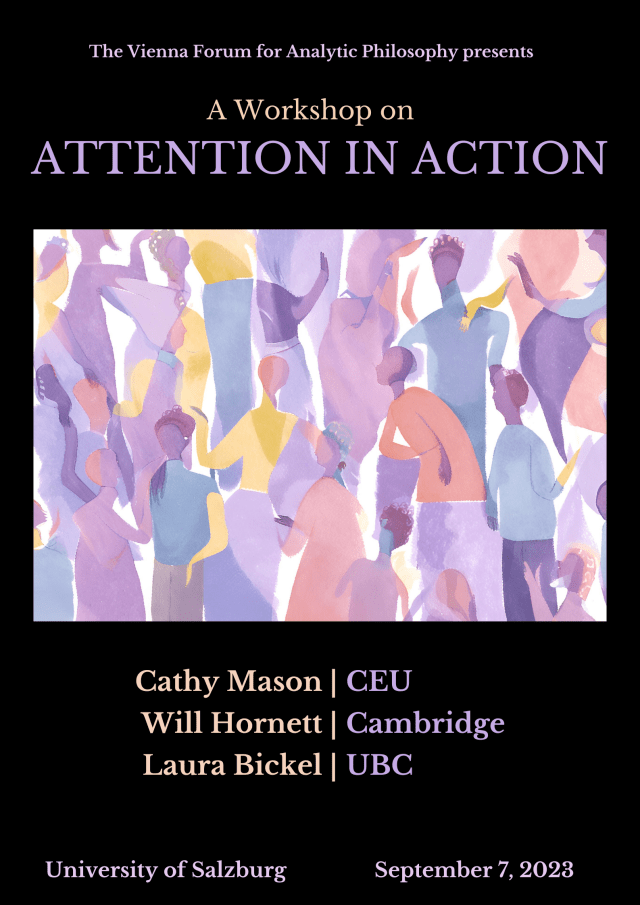
Attention plays an important role for us as agents. I thinking about what to do, we need to attend to the relevant features of our environment. And in finally doing what we set out to do, we need to constantly update our information as to whether or not we are still on track in achieving our aim. In fact, acting without any involvement of attention (however automated and implicit) seems well-nigh impossible! Yet, how exactly attention figures in action is still radically undertheorized. The first action-theoretic account of attention has only recently been proposed by Wayne Wu (2011), but work in this fascinating field is, over all, still only in its infancy.
This workshop is dedicated to work in this up-and-coming debate in philosophy – it is about the role attention plays in action. For this, we will have three talks concerning three related subfields. We will be hearing about the ethical implications of attention in action within the framework of Iris Murdoch’s philosophy, about the connection between attention and Anscombe’s notion of ‘practical knowledge’, and the implications of Wayne Wu’s account of attention in action for the philosophy of mind.
Where and When?
University of Salzburg
September 7, 2023
4pm – 7:30om (CET)
Schedule
4pm–5pm — Cathy Mason (CEU)
Break
5:15pm–6:15pm — Will Hornett (Cambridge)
Break
6:30pm–7:30om — Laura Bickel (University of British Columbia)
Abstracts
Cathy Mason (CEU)
Iris Murdoch (1970;1992) claims that action can only be understood in the context of vision and attention. This suggests that an individual’s actions can be understood in terms of what they see, or perhaps in terms of how they attend to they world. But this seems to lead to an odd claim: the claim that the person who is ill-motivated is simply blind to reality, or to parts of it. How is it possible to think that they fail to see (believe, know, grasp) the relevant features of reality? And in particular, how is it possible to think this if they are ill-motivated precisely vis-à-vis those features? What is going on, say, in the case of the bully who intentionally humiliates another person precisely because they see that such an action will be humiliating for the other and find such humiliation amusing? Surely they are not simply blind to that feature of reality? Murdoch’s answer, I will suggest, lies in the idea that there are different ways in which we can see (grasp, know) a thing: she takes motivation to be closely connected to vision, but not all vision of an object will therefore yield the motivation to act rightly regarding it. Only ‘depth knowledge’ of an object will do so.
Will Hornet (Cambridge)
Perception seems to be shot through with practical significance. We see objects as attractive, repulsive, obstacles, goals, too big, too close, and just the right shape. How? What is its significance? One classic answer associated with Merleau-Ponty connects perception’s practicality with skill: it is constitutive of being skilled that we percieve the world in these terms, and, since these experiences can motivate action, skill, too, can motivate action in a way that bypasses intention. I will argue that some of this is right, and some of it wrong. What is wrong is that skills can motivate action at all: they cannot explain why someone does something, since they are capacities, a type of possibility, and capacities are unfit for explaining why things happen. When we see this, I argue, we will see that the only way perception could get its practical content is if the agent is already doing something intentionally. I will argue that this suggests that perception’s practicality is an expression of what Anscombe calls ‚practical knowledge‘, or ‚knowledge in intention‘. Such experiences do motivate action, but not in an intention-independent way. I will develop this suggestion, before suggesting that it shows there is something wrong with the distinction between endogenous and exogenous attention.
Laura Bickel (University of British Columbia)
Addiction-driven behavior often strikes us as unintelligible. For example, despite having good reasons not to smoke and deliberately trying to abstain, we might find ourselves again with a cigarette between our lips. In such cases, our addiction-driven behavior diverges from our explicit and narrative self-concept (“I don’t want to be a smoker”) and compromises our sense of agency.
In my talk, I suggest that addiction-driven actions become intelligible from the point of affect-biased attention. Drawing upon recent findings in affective cognitive neuroscience, I argue that the performance of habit-driven actions requires experiential history to be exerting an influence that is best understood as implicit selection-biasing. I suggest that experiential history, through sedimented affect-motivational biases, influences stimulus selection beneath the threshold of deliberative thinking and explicit goal setting. Analysing attentional processes involved in non-pathological habit formation provides the conceptual framework for understanding the regular influence of affect-motivational biases on information processing in addiction.
Incorporating insights from neuroscientific research on affect-biased attention as emotion regulation, I propose conceptualizing addiction in terms of an attentional practice that serves the continuity of a distinct type of self-experience, namely the affective self, by tuning one’s sensory filters to favor certain affectively salient stimuli and thereby generating and regulating subsequent emotional responses.
 mwniederl