
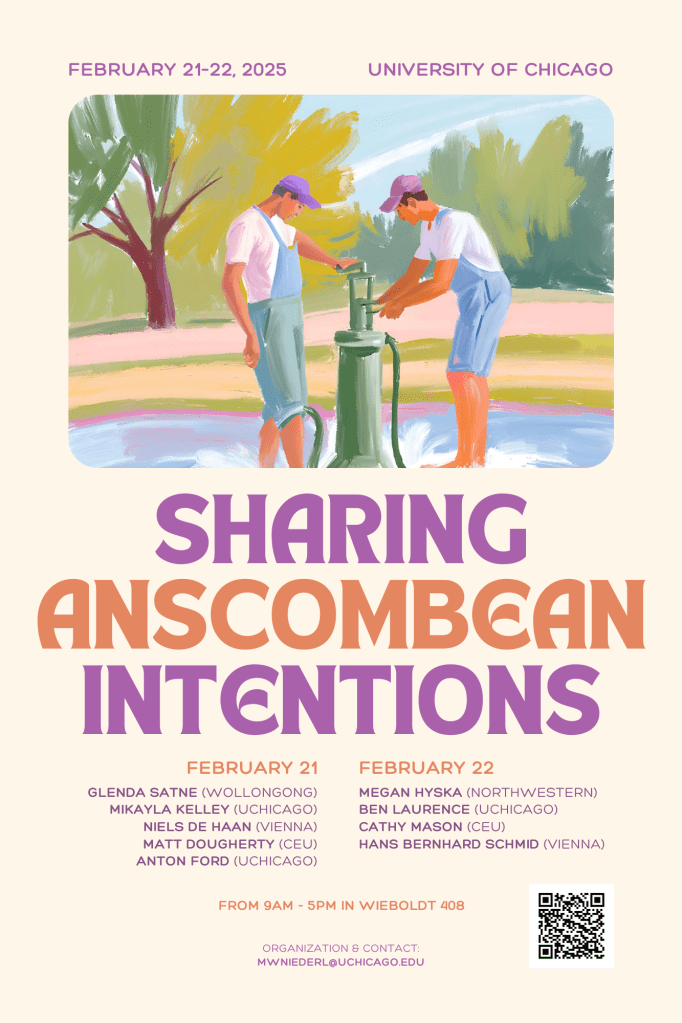
Elizabeth Anscombe is one of the most important figures in the contemporary philosophy of action. Yet her account of intentions and intentional actions is still largely absent in the now flourishing debates on social agency and collective intentionality.
With Chicago’s renowned expertise in Anscombe scholarship, and Vienna as the founding city of the International Society of Social Ontology, the aim of this workshop is to be part of the conversation that could finally fill this lacuna.
February 21–22, 2025
University of Chicago
Wieboldt Hall 408
1058 East 59th Street
Chicago, IL
Schedule
Friday, February 21
9am – 10.30am: Glenda Satne (Wollongong)
Plural Practical Knowledge: the Genus and the Species.
For Anscombe a solitary activity is intentional if the agent has self-knowledge of what she is doing. This knowledge is famously characterised by Anscombe as non-observational. Analogously, one might think that for several agents to partake in shared intentional activities is for them to have plural or collective self-knowledge of what they are doing together. I call this the ‘Plural practical knowledge’ thesis. Yet, against this thesis there seems to stand an obvious obstacle, a view that is widespread in contemporary analytic philosophy of mind and action, namely, that I can know practically and non-observationally what I do, but not what others do, for all knowledge of others is by nature observational. I argue that though this view is widespread in the literature, whether held implicitly or explicitly, it is not the most natural way to understand how we know others when we are engaged in joint action with them. To see this, we need to reflect on the right kind of cases. The activities that have served to illustrate theories of joint action, such as ‘painting a house’ (Bratman 1992), ‘walking together’ (Gilbert 1990), ‘cooking dinner together’ (Searle 1990), ‘pulling a pram onto a bus’ (Butterfill 2012) are activities that individuals might perform alone, in parallel, as well as together with others. The key to the debate between the competing theories is to determine the components, necessary and/or sufficient, for these activities to be done jointly with others, rather than alone or in parallel. In contrast, I focus on activities which cannot be carried out alone or in parallel, but only together with others. In these cases, agents engage in joint activities they understand as being necessarily shared with other agents. Upon considering these activities, the paper offers an account of plural practical knowledge according to which agents engaged in these activities know what they are jointly doing. It then proposes a paradigmatic methodology that generalizes the account to understand what different cases of collective intentional action have in common, including those which involve agents widely spread in time and space, which, prima facie, seem to contradict the plural practical knowledge thesis.
11am – 12.30pm: Matt Dougherty (CEU)
On Practical Knowledge, Observation, and Whether Action Has Its Own Kind of Sight
Abstract: Anscombe argues that the knowledge we have of what we are intentionally doing is non-observational, denying that there is any ‘strange kind of seeing eye in the middle of action’. In this talk, I try to show that the narrowness of her notion of ‘observation’ allows for the possibility that action, despite being non-observational, has its own kind of sight – thus admitting a kind of seeing eye into the middle of action. I’ll also try to draw out some implications of this view for our practical knowledge of joint intentional action.
Lunch break
1.30pm – 3pm: Mikayla Kelley (UChicago)
Acting with Objects
We have a capacity to act intentionally with other human agents and a capacity to intentionally produce changes in inanimate objects. The goal of this project is to show that the latter is closely related to the former in being a form of joint agency. In doing so, I weigh in on existing debates about the nature of joint agency and the limits of individual agency.
3.15pm – 4.45pm: Niels de Haan (Vienna)
The Success Conditions of Shared Intentions
Due to their mind-to-world direction of fit, intentions have success conditions. And yet our intentions are opaque to various degrees. This generates a puzzle concerning how to individuate intentions. There are cases where the propositional content of the initial intention remains the same, but the intention and success conditions seem to have changed. This puzzle cannot be solved via the de re / de dicto distinction of intentions. Hence, the identity of intentions and their success conditions cannot always be determined solely in virtue of its propositional content. Instead, I argue that the success conditions of intentions are in part determined by the agent’s practical standpoint (their background beliefs, commitments, cares, ends, values, etc.). Even when our intentions are opaque, we typically know what we are not doing. I call this negative practical knowledge. The agent’s practical standpoint creates defeaters, which designate what does not count as a success and help determine the success conditions of intentions. Next, I explore the relevance of this for shared intentions and shared action. I argue that this poses problems for certain non-reductive views, in particular for Raimo Tuomela’s account of we-mode joint action (2013). The non-reducibility of we-mode joint action depends partly on the collectivity condition: it is necessarily the case that the goal is satisfied for the we-mode group only if it is satisfied simultaneously and interdependently for all members. For this to be the case, the success conditions of we-mode we-intentions must be identical. But if the success conditions of intentions are determined in part by an agent’s practical standpoint, this is practically speaking impossible.
5pm – 6.30pm: Anton Ford (UChicago)
Help
This is a plea for help. In his 1956 paper, “A Plea for Excuses,” J. L. Austin argued for the interest of a topic, excuses, which he hoped would allow “the philosophical study of human conduct” to get off to “a positive fresh start.” In arguing his case, Austin attempted to say what the topic was, why it was worth studying, and how it might be studied. I propose to try something similar. I will argue that, although it is seldom thematized by contemporary philosophers, help is a concept of foundational importance to the philosophy of action (including but not limited to the study of collective agency), to moral and political philosophy, and to the theory of mutual recognition. It is, in other words, a fundamental topic of practical philosophy.
Saturday, February 22
CANCELLED — 9am – 10.30am: Megan Hyska (Northwestern)
On Cooptation
Cooptation is a phenomenon of interest in the study of contentious politics, where it is understood as a classic tactic for defusing the power of a political challenger. I argue that cooptation is also an understudied form of collective action, in the sense that it is a phenomenon that can only be studied by looking at how multiple individual actors’ action-theoretic states inter-relate. I attempt to clear the ground for future philosophical work on this subject by distinguishing several distinct notions of cooptation, and by laying out a few interesting questions that arise when we pull the phenomena associated with these notions into philosophical focus.
11am – 12.30pm: Ben Laurence (UChicago)
Which Philosophy of Action for Agents of Change?
This talk asks what philosophy of action is best suited to capture the diverse forms of agency crucial to political action and change. I argue that an Anscombean approach to collective action that highlights a novel sense of the question “why?” and associated forms of action explanation does better than rival views. I also respond along the way to outstanding criticisms of this approach, arguing that these criticisms founder on the fact that the division of labor in collective action is simultaneously a division of knowledge, including in what these critics (wrongly in my view) think of as paradigm cases of collective action.
Lunch break
1.30pm – 3pm: Cathy Mason (CEU)
Anscombe, Joint Action, and the Guise of the Good
The notion of the guise of the good plays a crucial role in Anscombe’s account of action. However, it is hard to see how it could be incorporated into an account of joint action. In this paper, I explain what I see as the difficulty here, and why it cannot be straightforwardly thus incorporated. I will then sketch three potential responses on behalf of the Anscombean theorist of joint action. Each way of doing so, I suggest, risks either undermining the appeal of Anscombe’s account of action or failing to account for the initial cases that motivated consideration of joint action.
3.30pm – 5pm: Hans Bernhard Schmid (Vienna)
tba
 mwniederl